

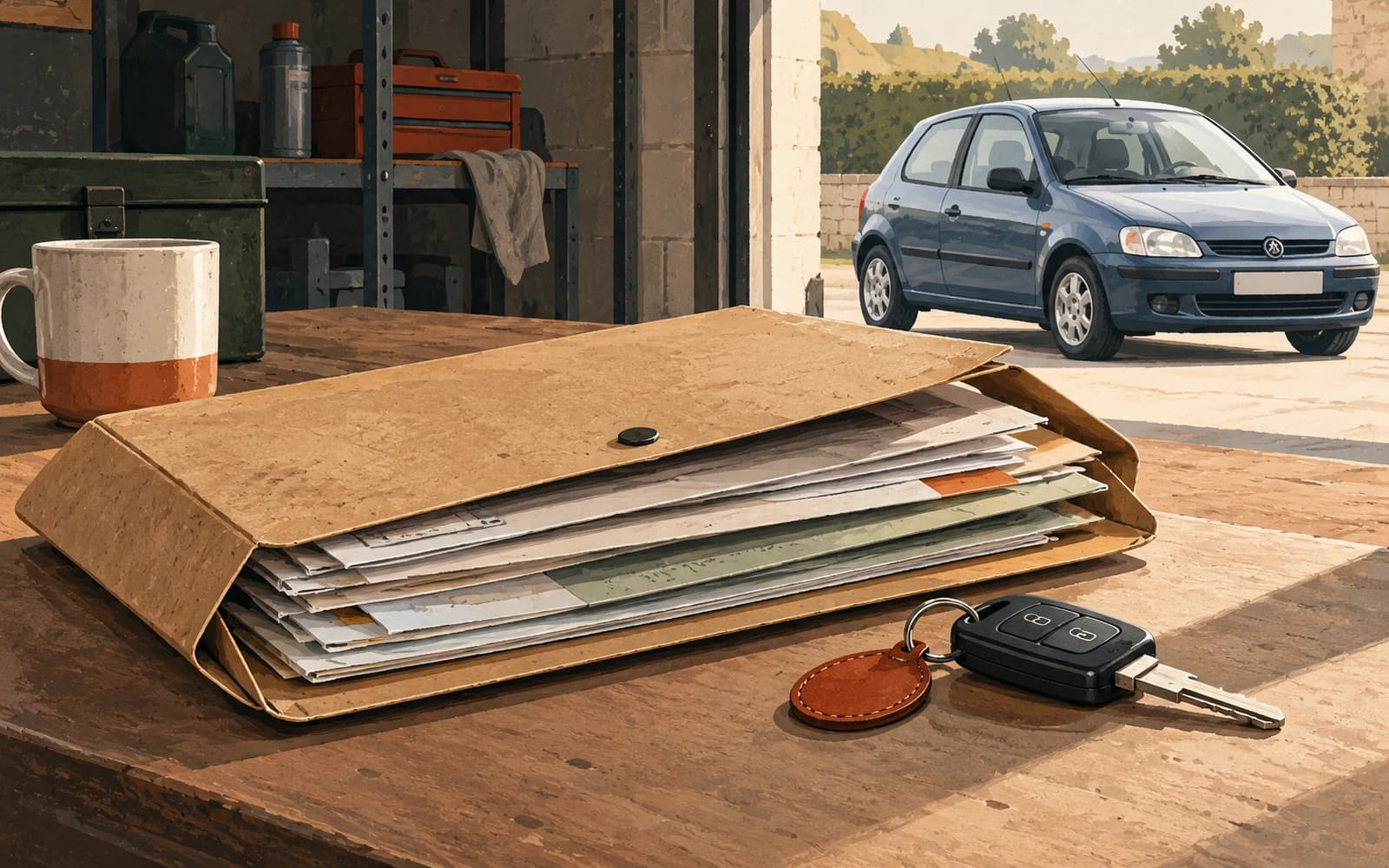
A used car's paperwork can help you understand its identity, maintenance and earlier problems. The useful part is how the records fit together, not simply how thick the folder looks.
Read the documents alongside the car and the seller's account. They are evidence to examine, rather than a substitute for viewing the vehicle and arranging an inspection where needed.
Begin with the vehicle's identity
Follow the official used-vehicle checks. Compare the registration details and vehicle identification number with the vehicle and its documents. Ask the seller to explain a discrepancy before treating it as a harmless clerical error.
The V5C records the registered keeper; it is not proof of ownership. The police explain that distinction. Establish that the seller has the right to sell the vehicle, and keep a proper purchase receipt if you proceed.
Maintenance records also do not answer every question about outstanding finance, theft or an insurance write-off. Carry out the appropriate vehicle-history checks, understanding what the particular service covers.
Read service invoices for the work they describe
Look for dates, mileage, vehicle details and descriptions of completed work. Check which significant scheduled items are evidenced and whether the pattern fits the manufacturer's requirements for that version.
A stamp, an invoice and a digital manufacturer record may give different levels of detail. Ask for the supporting evidence where a major job matters to your decision. "Fully serviced" in an advert needs explaining in terms of actual work and intervals.
Make sure an estimate has not been mistaken for a paid repair invoice. A list of recommendations tells you what someone proposed, not necessarily what the owner authorised or completed.
Look at the MOT history separately
Use the GOV.UK MOT history service to check available results and recorded mileage. Compare it with the supplied paperwork rather than relying only on a photograph of the latest certificate.
Ask about repeated findings, gaps or mileage inconsistencies. The history can point you towards questions; it does not diagnose the vehicle's present condition. A pass is not evidence of every service or proof that a later repair was performed.
Make gaps part of the conversation
Ask why a period is undocumented and whether other evidence exists. A car may have been stored, maintained by its owner or serviced through a system the seller has not printed out. Those possibilities need establishing, not assuming.
Keep an account of what the seller says, particularly where it affects the price or description. If an important replacement is unproven, ask a suitable garage what that uncertainty means before you commit.
If the car is already yours, our guide to recovering missing service records explains how to start building an honest timeline.
Use the paperwork to guide the inspection
Give an inspector relevant earlier findings, repair invoices and unanswered questions. A recent bill for substantial work may be useful, but the document cannot independently establish how well every part was fitted.
Consider the whole picture: what the seller claims, what the evidence supports and what the vehicle's condition shows. Where those do not agree, investigate before paying rather than hoping a thick folder will make the uncertainty disappear.