

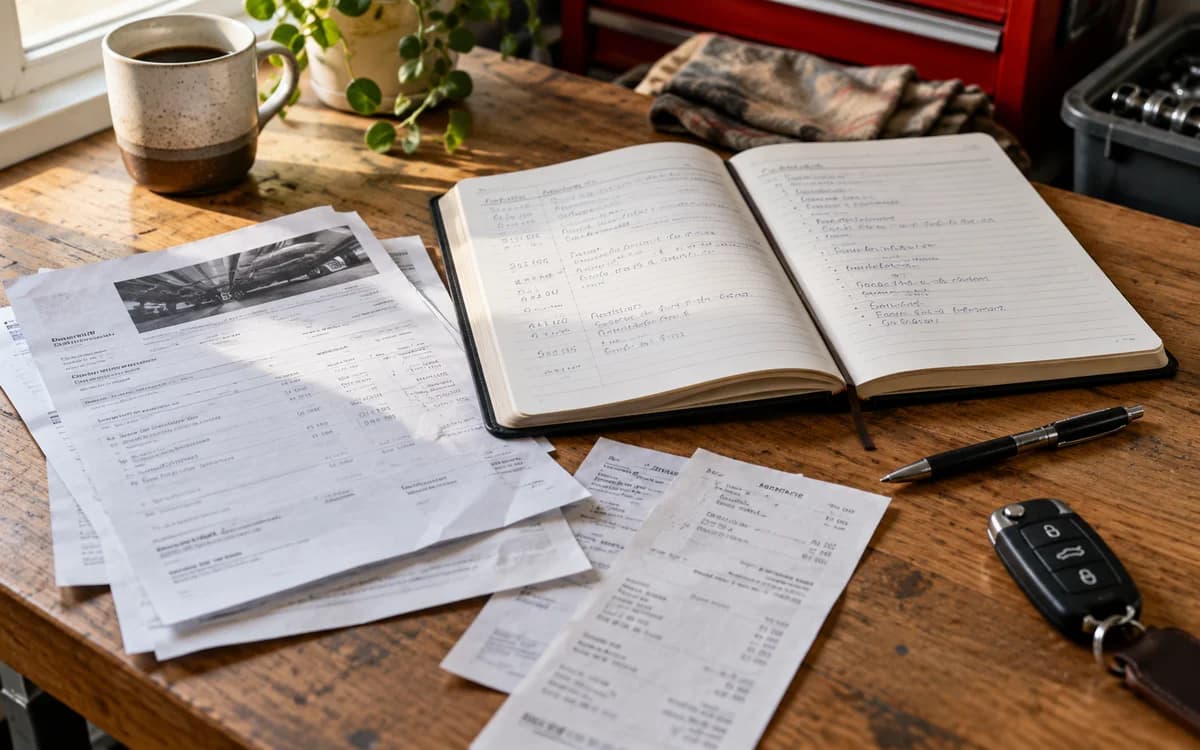
A useful service record lets you answer a straightforward question: what work was done, when, and where is the evidence? You do not need a long account of every visit. You need enough detail to understand the work later and find the original invoice.
What to record after a service or repair
- The date the work was completed.
- The odometer reading, including whether it is miles or kilometres.
- A clear description of the work.
- The garage or person who did it.
- The amount paid and the currency.
- The invoice, receipt or other supporting document.
For parts with a particular specification, keep the document that identifies what was fitted. A note saying "oil changed" is less useful than an invoice that records the oil specification, filter and work completed.
An example service entry
Imagine a service completed on 12 October 2026 at 62,410 miles. A useful entry might say:
Oil and filter service at Example Garage. Engine oil and filter replaced. Invoice attached. Total paid: £185.
This is an illustration, not a service-price estimate or a maintenance recommendation. Use the actual work, mileage and amount from your paperwork. If you carried out a job yourself, say so and keep the parts receipt. Do not present a DIY entry as a garage service.
In Carstoric's maintenance log, add a dated event to the vehicle timeline, record the mileage, cost and notes, then attach the evidence. Keep unfinished jobs in issues or to-dos so they are not confused with completed maintenance.
Bring older paperwork into order
Start with dated invoices and work forwards. Match each document to the right vehicle and mileage before adding it. Photograph or scan the whole page, including the garage details and description of the work. Check that the text is readable before putting the original away.
If a date or mileage is unknown, record that uncertainty in your notes. Do not guess a service interval or describe work as completed merely because it was recommended on an estimate. A quote records proposed work; an invoice usually gives different evidence.
Keep original documents when they matter. A photograph is useful for finding information quickly, but a buyer, warranty provider or other organisation may still ask for the original evidence.
Keep MOT records separate from servicing
An MOT test and a service answer different questions. The MOT record shows the available test history, including results and recorded defects. It does not list every service or repair. Read our guide to MOT history and service history before treating the two as interchangeable.
If an advisory led to repair work, keep the test result and the later repair entry. Do not mark a job as completed until you have evidence that it happened.
Keep an independent copy
Export your garage from Settings when you need a copy of your Carstoric records, and keep independent copies of important invoices. Before sharing paperwork, check it for personal details about you or previous owners. Share only the information needed for the purpose.
Carstoric entries are records you supply. They do not become manufacturer-verified service history simply because they are stored in an app. A clear description and original evidence make the record more useful without overstating what it proves.
Free includes one vehicle and two attachments per event. Compare Free and Plus if you need more room for your garage.